
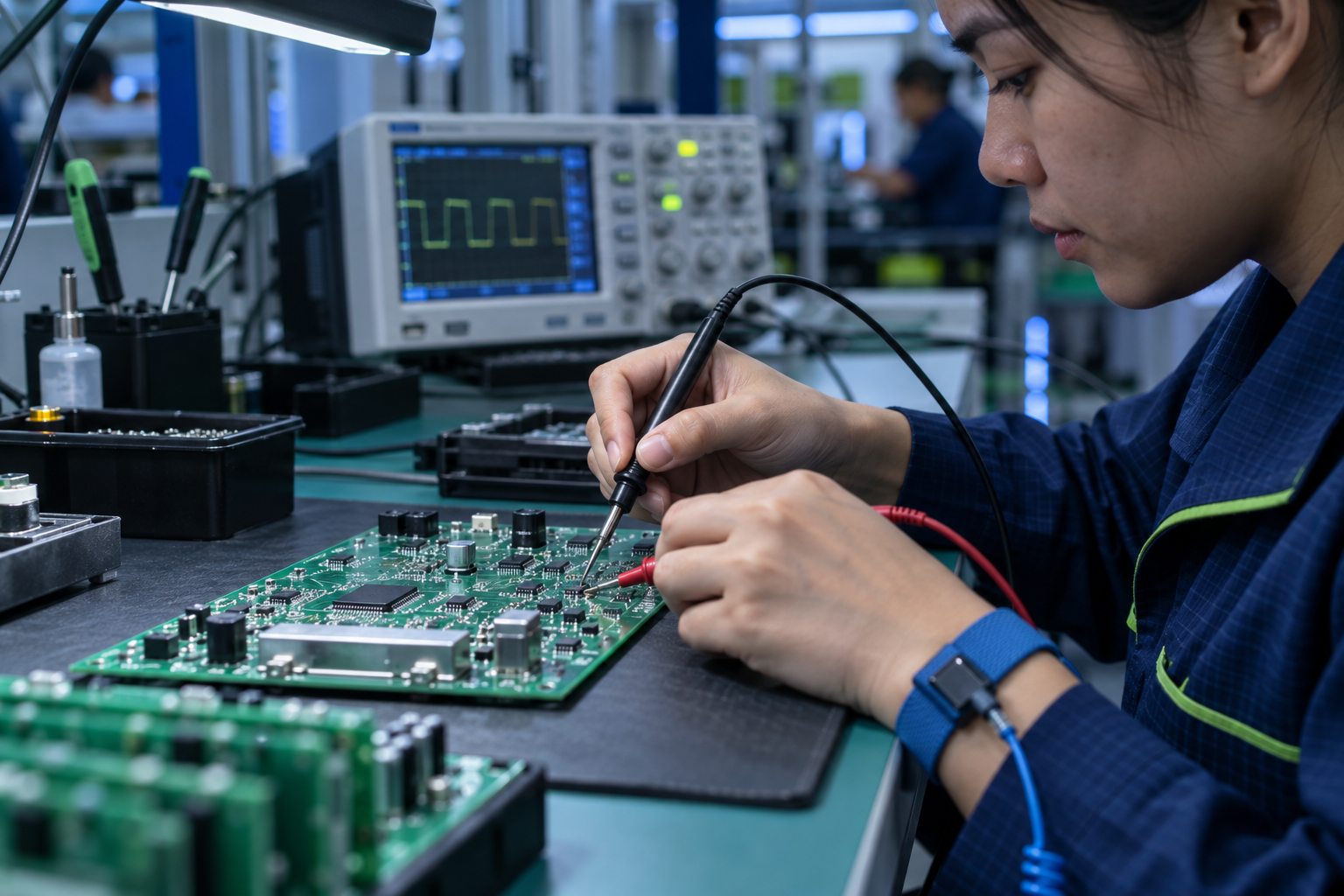
Separate “it works” from “we can build it repeatedly”
A prototype demonstrates an idea. Production requires a process that can deliver consistent results across repeated builds. The transition involves the design, materials, assembly sequence, test methods, documentation and the people responsible for each step.
Start by recording what was improvised during the prototype build. Hand modifications, undocumented substitutions and one-off assembly tricks are useful clues to work that remains.
Review the design with manufacturing in mind
Ask the intended manufacturing partner to review the design for the actual processes being considered. Discuss tolerances, material availability, access for assembly and inspection, component placement, fixture needs and likely sources of variation.
Treat this review as a two-way discussion. A proposed manufacturing improvement may affect appearance, performance, repairability or certification. The product owner should approve changes through a controlled process.
Define what a passing unit means
- List the product functions and characteristics that must be checked.
- Agree test limits, equipment needs, calibration responsibilities and how results will be recorded.
- Define handling for failed units, rework, retesting and disposition.
- Prepare assembly instructions, a controlled bill of materials and approved revision records.
- Identify product-specific regulatory and safety requirements with qualified specialists before deciding the validation plan.
Make the pilot answer practical questions
Use a pilot build to learn whether the documentation, materials, process and testing work together. Record the issues, yield observations and changes needed; do not treat a small successful build as proof that every scaling risk is resolved.
Agree who closes each issue and what evidence is required. Before release to the next build, check that approved changes appear in the relevant drawings, BOM, work instructions and test procedures.
Plan the next build before the first one ends
Confirm material lead times, tooling availability, capacity assumptions, replenishment planning and the route for engineering changes. Ask how the supplier will alert you to shortages or process changes.
Your next action: use the OEM2EMS Product Journey to identify your current stage, then choose the milestone that would remove the biggest uncertainty before your next manufacturing conversation.
Further reading
For an example of manufacturing feedback in practice, see Protolabs’ introduction to manufacturing analysis ↗.
These are educational references; inclusion does not indicate membership in or endorsement of the OEM2EMS supplier network.